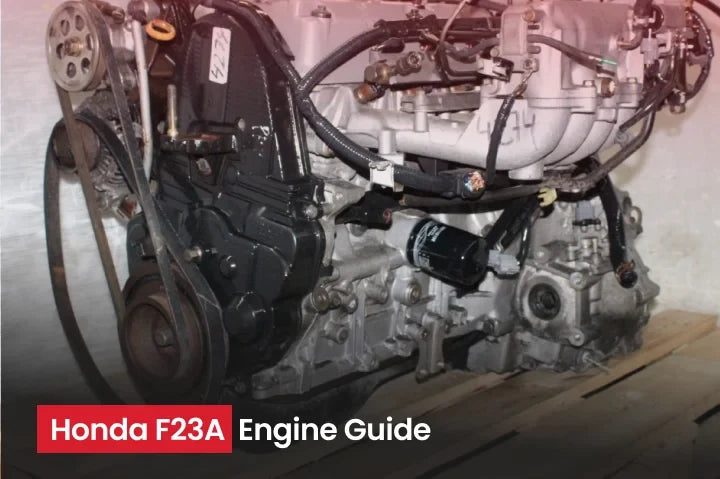
The Honda F23A is a 2.3L four-cylinder engine built for the 1998 to 2002 Accord. Most versions use single-camm VTEC and make about 150 hp. The base DX version skips VTEC. This guide covers specs, engine codes, common problems, and what to check before you buy a used one.
Honda sold the engine in a few other models too. It’s a tough, simple design. It also has a few quirks, and a timing belt you shouldn’t ignore.
What Is the Honda F23A Engine?
The F23A belongs to the Honda F engine family, a line of single overhead cam four-cylinder engines. Honda used them in the Accord and Prelude for years. The 1997 Accord ran a 2.2L F22 engine. For 1998, Honda moved up to the 2.3L F23A.
It’s a naturally aspirated engine with fuel injection and an aluminum head. Most versions add VTEC, which switches to a sportier valve profile at higher RPM. That’s why a plain family sedan engine feels a bit livelier near the top of the rev range.
Compare It With the F20B
The F20B is a 2.0L cousin with a different personality. Our Honda F20B engine guide is worth a read if you’re weighing F series options.
F23A Specs: 2.3L SOHC VTEC Power and Torque
Here’s how the two main versions compare. Numbers vary slightly by source and model year, so treat them as close estimates.
|
Spec |
F23A1 (VTEC) |
F23A5 (no VTEC) |
|
Displacement |
2,254 cc |
2,254 cc |
|
Bore x stroke |
86 x 97 mm |
86 x 97 mm |
|
Compression ratio |
9.3 to 1 |
8.8 to 1 |
|
Power |
About 150 hp |
About 135 hp |
|
Torque |
About 152 lb-ft |
About 145 lb-ft |
|
Valvetrain |
SOHC, 16-valve |
SOHC, 16-valve |
|
Timing drive |
Belt |
Belt |
|
Oil |
5W30, about 4.5 quarts |
5W30, about 4.5 quarts |
The engine weighs roughly 320 lb. It doesn’t use hydraulic lifters, so the valves need periodic adjustment. Some sources say every 25,000 miles or so. Check your service manual for the exact interval.
Which Cars Use the F23A: 1998-2002 Accord, 1998 Odyssey and Isuzu Oasis
The Accord is the main home for this engine. You’ll also find it in a few related vehicles.
-
Honda Accord, 1998 to 2002: DX, LX, EX and SE trims with the 2.3L four-cylinder.
-
Acura 2.3CL: Roughly 1998 to 1999.
-
Honda Odyssey: The 1998 US model, plus some earlier and later Japan market versions.
-
Isuzu Oasis: A rebadged Honda Odyssey.
Fitment isn’t always clean, though. Check the VIN and the emissions label before you order anything.
Shop a 1998 to 2002 Accord F23A Engine
If you’re swapping an Accord, start with this 1998 to 2002 Honda Accord JDM F23A engine. It’s a low-mileage import, and we compression-test it before it ships.
F23A Engine Codes: F23A1, F23A4 ULEV and F23A5
Honda used several codes for what looks like one engine. Each code points to a trim level or an emissions rating.
|
Code |
Typical trims |
VTEC |
Emissions |
Power |
|
F23A1 |
LX, EX, SE |
Yes |
Standard |
About 150 hp |
|
F23A4 |
LX, EX, SE |
Yes |
ULEV |
About 148 hp |
|
F23A5 |
DX |
No |
Standard |
About 135 hp |
ULEV stands for ultra-low-emission vehicle. The F23A4 is very close to the F23A1, though a few sources report a small power drop. Some parts, like the ECU and exhaust pieces, can differ. So match the code before you order.
The F23A5 is the odd one out. It skips VTEC entirely, which explains the lower power. Some owners swap a VTEC engine into a DX for that reason.
Is the Honda F23A Reliable? Common F23A Problems
Mostly, yes. One source claims a lifespan around 350,000 km, or about 215,000 miles. That’s optimistic, but a well-kept F23A can go a long way. It depends on the oil changes and the belt.
Owners report these issues most often:
-
Oil use: Some engines burn oil after roughly 60,000 miles.
-
Leaks: Oil and coolant leaks show up with age.
-
Rough idle: A dirty idle air control valve or EGR passage often causes surging or stalling.
-
Valve noise: Skipped valve adjustments lead to a ticking sound.
-
Timing belt: One source suggests changing it around 60,000 miles. Follow your manual if it says otherwise.
The belt matters most. Most sources call the F23A an interference engine. If the belt snaps, the pistons can hit the valves. That repair costs far more than a new belt and water pump.
So ask for proof of the last belt change. If there’s none, plan on doing it right away.
Buying a Used JDM F23A Engine: Fitment Checks
A used import can save you a lot of money. It also needs a little homework. Ask the seller for the stamped engine code, the mileage, and the included parts.
Before you pay, run through this short list:
-
Confirm the engine code matches your car.
-
Check whether it’s a ULEV or standard version.
-
Ask what comes with it (head, block, accessories, ECU).
-
Look at photos of the actual unit, not stock images.
-
Ask about warranty and return terms.
Confirm Fitment Before You Order
Not sure what fits? Browse our Honda and Acura engines. You can also call us with your year, make, and model, and we’ll confirm before you buy.
Match the Transmission
The engine is only half the swap. Many Accord owners replace the gearbox at the same time. Our F23A automatic transmission is built for the 2.3L four-cylinder.
Inspect It Before You Install It
Once the engine arrives, spend twenty minutes checking it before it goes near your car. Our guide on how to inspect a used JDM engine before you install it walks you through the steps.
Honda F23A Engine FAQs
Does the F23A have VTEC?
Most do. The F23A1 and F23A4 both use VTEC, which changes valve timing at higher RPM for extra power. The F23A5, found in the base DX, doesn’t have it. Check the engine code stamped on the block if you’re not sure which version you own.
What is the difference between F23A1 and F23A4?
Both are VTEC engines from the same family. The F23A1 is the standard version. The F23A4 carries ULEV certification, so it’s tuned for lower emissions. Power is nearly the same, though some sources list the F23A4 slightly lower. Always match the exact code when you buy parts or a replacement engine.
Is the F23A an interference engine?
Most sources say yes. If the timing belt breaks, the pistons can strike the open valves and bend them. That’s why belt changes matter so much on this engine. Confirm the details in a factory service manual for your exact model year before you rely on this.